How it works
Ammonia absorption-compression heat pump
Principle of ammonia absorption-compression heat pump
The Ammonia Absorption-Compression Heat Pump (ACHP) combines thermochemical absorption with mechanical compression to achieve large temperature lifts and high process temperatures efficiently. Unlike conventional heat pumps, the ammonia-water working pair allows a reduction in pressure ratio by adjusing the solution concentration, improving overall system performance.
Thanks to the thermodynamic properties of the ammonia-water mixture, heat can be transferred along gliding temperature profiles, making the process particularly suitable for industrial heat sources and heat sinks with large temperature differences. This minimizes heat exchanger losses and enables high efficiency.
By combining absorption and compression in a single system, the ACHP can deliver process temperatures above 150 °C while utilizing natural working fluids only. This makes it an attractive solution for industrial waste heat recovery, process heat generation, and industrial decarbonization.
How the Absorption-Compression cycle works
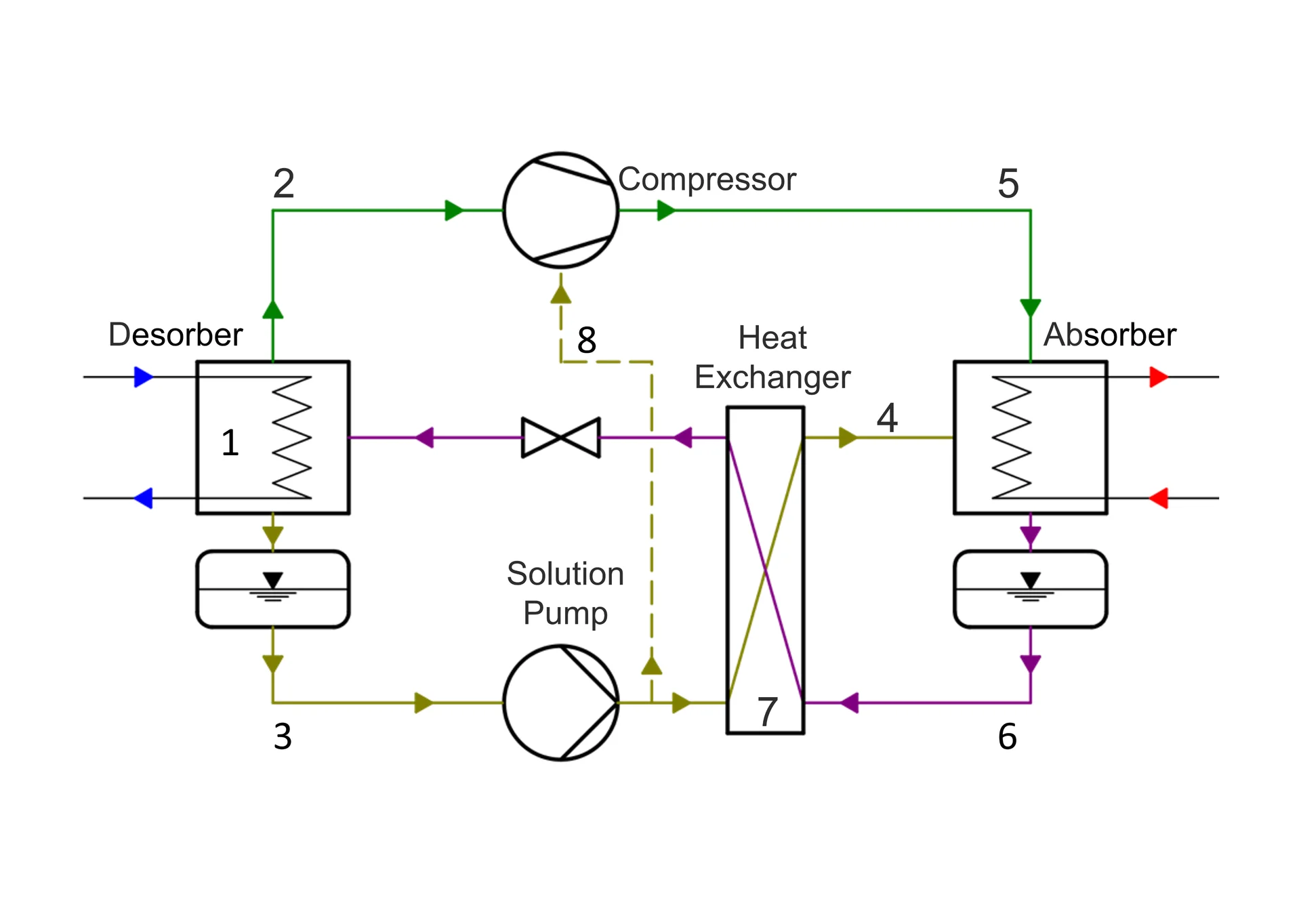
The absorption-compression cycle combines a conventional refrigerant cycle with an ammonia-water solution circuit to efficiently upgrade low-grade heat to high-temperature process heat.
In the evaporator, the ammonia-rich solution absorbs heat and releases ammonia vapor, which is elevated to a higher pressure level by a compressor. At the same time, the ammonia-lean solution is pressurized by a pump.
In the absorber, the compressed ammonia vapor is reabsorbed by the weka solution, releasing heat at a high temperature level for industrial processes or steam generation. The cycle is completed by expanding the ammonia-rich solution back to low pressure.
Internal heat recovery preheats the solution and improves overall efficiency, while optional solution injection reduces compressor discharge temperatures and enhances performance.
Advantages of Ammonia Absorption-Compression Heat Pumps
The Ammonia Absorption-Compression Heat Pump (ACHP) combines thermochemical absorption and mechanical compression to deliver process heat and steam at temperatures exceeding 150 °C. Large temperature lifts of more than 75 K can be achieved within a single system, enabling the efficient utilization of low-grade industrial waste heat.
The ammonia-water working pair reduces compression ratios, improves efficiency, and enables excellent integration with industrial processes featuring large temperature differences. Using only natural working fluids (NH₃ and H₂O), the ACHP provides a sustainable and future-proof solution for industrial heat generation.
By recovering and upgrading waste heat, the technology reduces energy consumption, lowers CO₂ emissions, and supports the decarbonization of industrial processes. Combined with BL Thermodynamics' oil-free Howden screw compressor technology, the system delivers high reliability, efficiency, and performance.